
Supporting Healthcare
with Data
Data Index Corporation is a leading company in the field of
pharmaceutical databases within Japan.
We contribute to the further
development of healthcare through data.
Continuously evolving comprehensive
pharmaceutical database

Rxlib is a pharmaceutical database with extensive high-quality data which can
be used for various applications. It is made possible by proprietary data processing technology and
maintenance performed by pharmacists and expert staff.
The continuously evolving Rxlib contributes
to advances in “data healthcare” by providing a pharmaceutical database which can help treat
illnesses and support people’s wellbeing.
Rxlib is the international brand name for Xlib, a pharmaceutical database sold in Japan.
Mission
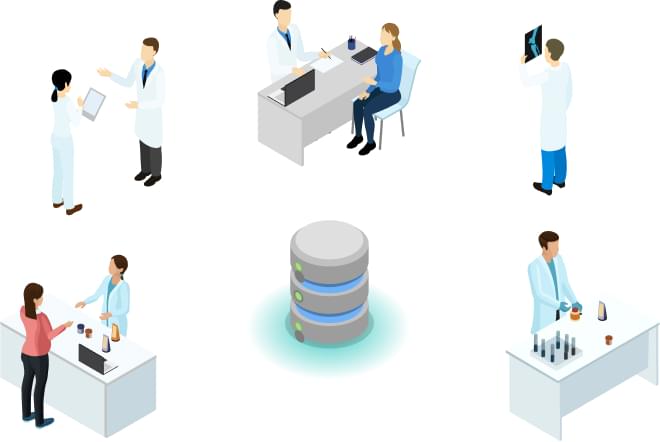
Empowering medical and healthcare professionals and patients through information
Data Index Corporation was founded with a deep commitment to saving lives. We contribute to Japanese healthcare through information by creating high-quality databases using our advanced expertise and technology. We also aim to be a driving force in medical innovation.
Our Solution
What Data Index Offers
We provide a pharmaceutical database built on data from government agencies and medical institutions. Hospitals and clinics use it via Electronic Health Records (EHR), and pharmacies use it through pharmacy management systems and electronic medication record systems. Additionally, universities, web service providers, app developers, and others use it.
Our DI business in Japan
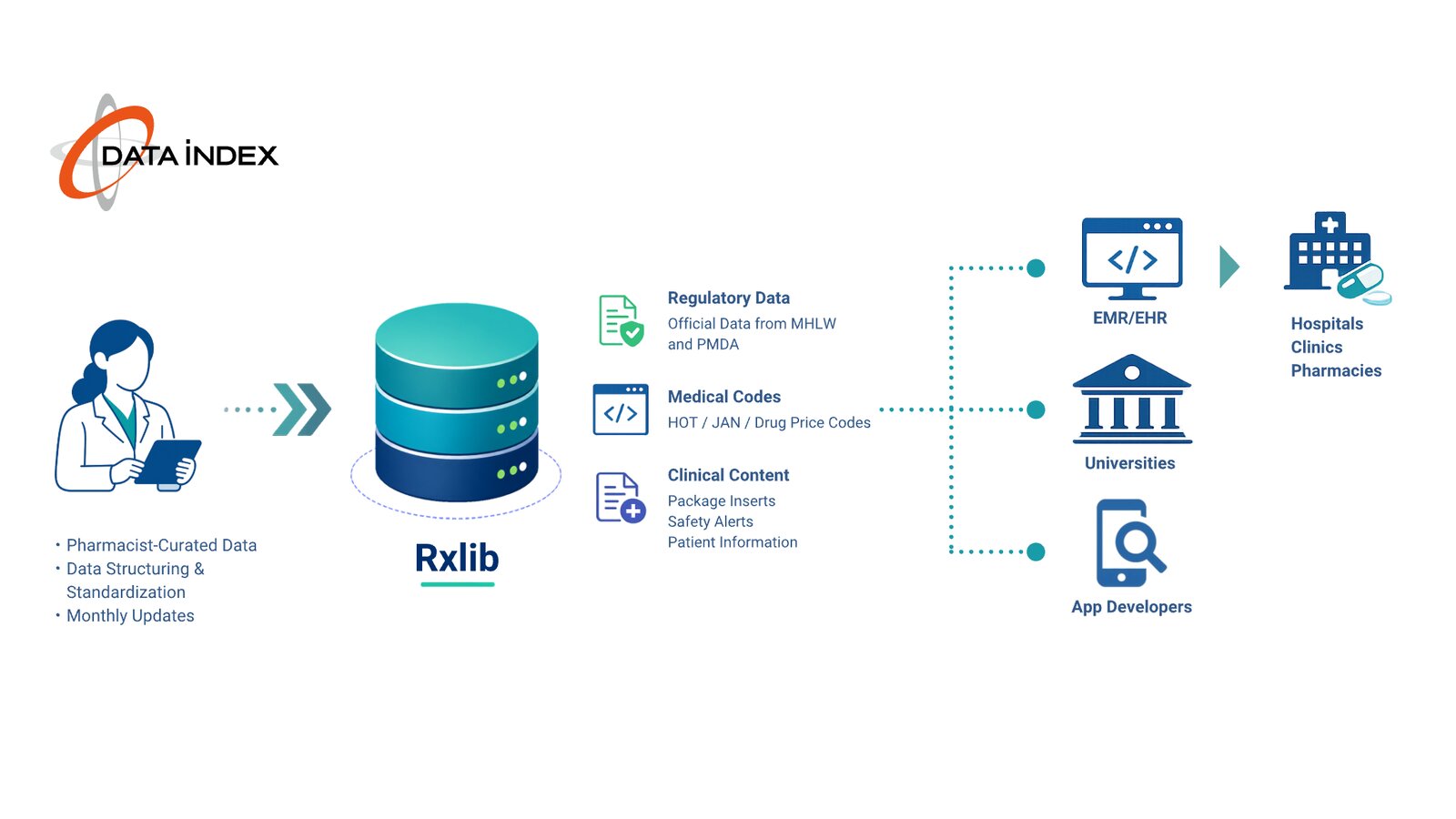
We collect and integrate drug data into a single platform and continuously update it. You can access our database (“DB”) through EMR/EHR systems and healthcare apps.
Clients



Many other global companies, such as NEC, also use our database.
Over 70,000 Facilities Adopted
Top-tier Implementation Track Record
Our comprehensive drug information database is integrated into various systems used in medical institutions, such as electronic health records, electronic medication record systems, and medical billing systems. We have an industry-leading track record with over 70,000 facilities nationwide*, earning high praise from many medical professionals and system vendors. Furthermore, it is also utilized for pharmaceutical-related research in public institutions like universities.

Over 100 types of databases100% coverage of approved pharmaceutical products in Japan
Over 100 types of databases, 100% coverage of prescription drugs and OTC drug items.
The databases held by Data Index not only contain basic information such as drug product names, generic names, drug prices, and various codes, but also provide databases that cater to all needs, including disease names, side effects, interactions, anti-doping, and ATC classification. Our databases cover approximately 21,000 prescription drug products and 12,000 OTC products, and by freely combining these databases, users can utilize them for various purposes such as prescription checks, checks necessary for insurance claims, medication guidance to patients, analysis and research using drug information databases, and medical management consultation.

resulting in a retention rate exceeding 95%
Data Index’s proprietary database is not only utilized by numerous clients but has also been continuously in use since our founding in 1985. We strive to maintain the freshness and quality of our information through continuous database updates performed by dedicated pharmacists and staff with specialized skills in the medical and IT fields, resulting in a retention rate exceeding 95%. Furthermore, we are committed to enhancing customer experience by promptly addressing inquiries and responding to requests.
*Percentage of customers under contract who renewed the following year (2024).

Adoption of our database in Japan
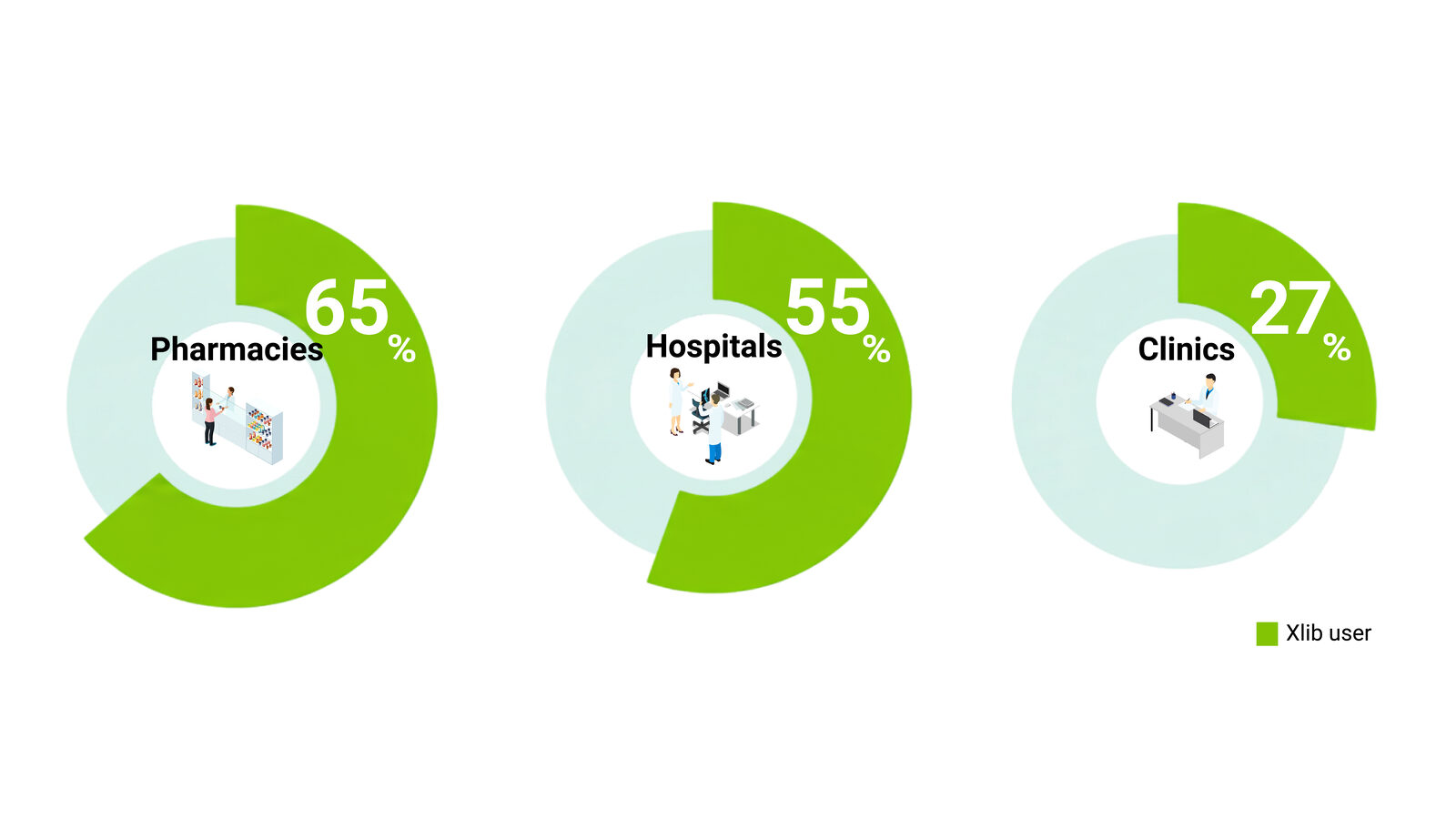
As of 2026, our database is integrated into systems used by 65% of pharmacies, 55% of hospitals, and 27% of clinics in Japan. “Installed” refers to facilities using systems integrated with Data Index databases.
Comprehensive coverage of pharmaceutical information
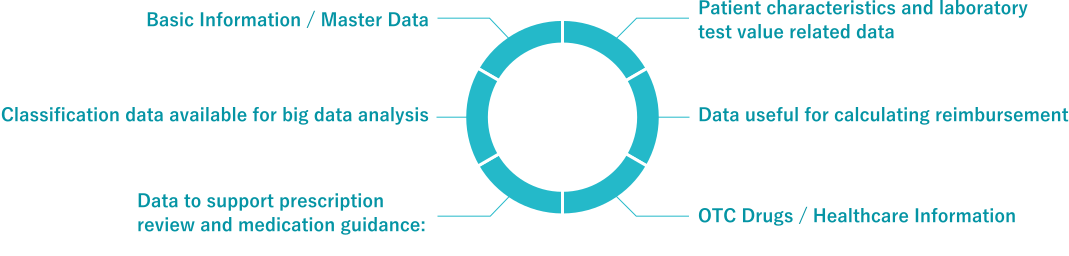
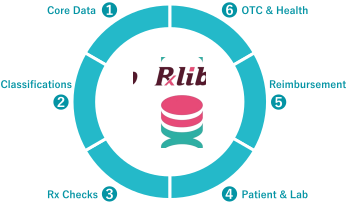
1Basic Information / Master Data
- Medical Prescription Drug Master DB
- YJ Code New/Old Comparison DB
- Medical Prescription Drug Packaging Unit DB
- Pharmaceutical HOT Code Management DB
- OTC Drug Master DB
- OTC Packaging Unit DB
2Classification data available for big data analysis
- ATC Classification DB (WHO version)
- ATC Classification DB (EPHMRA version)
- Therapeutic Drug / Equivalent Drug Classification DB
- Pharmaceutical Category / Labeled Efficacy DB
- Accumulation of past data
3Data to support prescription review and medication guidance
- Duplicate medication check DB
- Dosage and administration timing DB
- Indication disease name DB (linked with Billing-coded diagnoses)
- Drugs unsuitable for crushing, splitting, or unit-dose packaging DB
- Interaction check (contraindications/precautions for concomitant use) DB
- Early adverse drug reaction symptoms DB
4Patient characteristics and laboratory test value related data
- Age and Sex Check DB
- Laboratory Test Value – Side Effect Check DB
- Pregnant and Breastfeeding Women Administration Check DB
- Geriatric Syndrome Risk Drugs DB
- Allergy Check DB
5Data useful for calculating reimbursement
- High-Risk Drug Database
- Database for Calculating Generic Drug Substitution Rates
- Biosimilar Database
- Specific Drug Therapy Management Database
- Chlorpromazine Equivalent Database
- Geriatric Syndrome Risk Drug Database
- Allergy Check Database
6OTC Drugs / Healthcare Information
- Medical Indications – OTC Caution DB
- Drug Information for Patients DB (Drug Information Sheet Version)
- Drug Information for Patients DB
- Health Tips Database
Rxlib Features
 Speedy Provision of the Latest Information
We promptly gather the latest revisions of drug package inserts, and our dedicated pharmacists and staff with specialized skills in the medical and IT fields maintain our database, ensuring rapid data updates.
We provide updated databases every month, with some databases available weekly. We also support real-time delivery, where information is processed and provided immediately upon acquisition.
 The Volume of Accumulated Information and Continuously Refined Quality
The volume and quality of information in Rxlib, which inherits our database accumulated since 1990, stand out among numerous pharmaceutical information databases. It comprehensively covers approximately 21,000 prescription drugs and 12,000 over-the-counter (OTC) drugs.
Furthermore, based on extensive customer feedback, we promptly develop databases tailored to clinical needs. Our maintenance, leveraging specialized knowledge, ensures comprehensive checks and accurate search results.
 Extensive Data Lineup and Flexible Combinations
As a result of continuous research and development, Rxlib has evolved to offer over 100 diverse databases. The flexible combination of these databases allows for their utilization in various applications such as prescription checks, insurance claims, and medication guidance for patients. Furthermore, by leveraging the pharmaceutical information databases, they can be instrumental in analysis, research, and medical management consulting.
 Support for Standardization of Medical Information
The names and codes for pharmaceuticals and diseases comply with those designated by the Ministry of Health, Labour and Welfare and those standardly used in the medical industry.
This facilitates system operation and integration with other systems.
 Pharmaceutical Expertise-Based Database
Our dedicated pharmacists leverage their knowledge and experience to interpret information sources from a pharmacological perspective and create data. We strive to provide data with high pharmacological expertise by referencing not only package inserts but also public documents and various literature as needed.
 Proprietary Information Processing Technology
Drug package inserts often contain different expressions even when they are synonymous. By processing these different expressions as synonyms (thesaurus creation), we prevent omissions in checks and search results. We perform optimal information processing for each database, including markup and classification of package insert descriptions according to certain rules, thesaurus creation of extracted and classified terms and phrases, and indexing with each drug and various standard masters.
Benefits
Benefit01
Risk Management in Pharmaceutical Prescribing and Dispensing
By freely combining and utilizing the databases, various checks for safe and appropriate prescribing and dispensing are possible.
Benefit02
Improved Operational Efficiency and Enhanced Quality and Throughput of Patient Care
A database designed with the daily tasks of medical professionals, including doctors and pharmacists, in mind, enables medical institutions to streamline operations and enhance both the quality and quantity of patient services.
Benefit03
Facilitating seamless collaboration between hospitals, clinics, and pharmacies (Inter-facility coordination).
Internal: Clinical departments ⇔ Pharmacy departments ⇔ Medical accounting departments ⇔ Nutrition departments ⇔ Laboratory departments, etc.
External: Hospital-to-hospital collaboration, hospital-to-clinic collaboration, hospital-to-pharmacy collaboration, pharmacy-to-pharmacy collaboration, regional medical collaboration, etc.
A database using standard codes, with versatility in mind, strengthens business collaboration both inside and outside medical institutions.
Benefit04
Utilization for medical management consulting
Rxlib is not limited to clinical applications. It can also be utilized for medical management consulting, such as providing pharmaceutical information in web services, multifaceted analysis and research in big data analysis, and optimizing delivery and inventory management.
Benefit05
Prompt Response to Changes in the Medical Environment
To respond to changes in the medical environment, such as revisions to medical service fees, our specialized staff constantly checks the latest rules and guidelines and promptly reflects them in our database. We not only incorporate new elements into our products but also develop new databases as needed, supporting medical institutions to always conduct their operations based on the latest and most accurate information.
Company Overview
Company Name
Address
[Tokyo office]Sumitomo Shibadaimon Building, 2-5-5 Shibadaimon, Minato-ku, Tokyo 105-0012
[Nagoya office]West Point 1413 9F, 14-13 Tsubaki-cho, Nakamura-ku, Nagoya, Aichi 453-0015
Capital
Principal Stockholder
Founded
Primary Business
Employee Certifications
Pharmaceutical
- Pharmacists
- Certified Sports Pharmacists
- Healthcare Information Technologists
- Medical data technologist
Engineers
- Database specialist
- Applied information technology engineer
- Fundamental Information Technology Engineers
(including holders of the former Second-Class Information Technology Engineer certification)
Primary Partner Bank
Officers
Access
Sumitomo Shibadaimon Building, 2-5-5 Shibadaimon, Minato-ku, Tokyo
105-0012Google map
※The building is different from “Sumitomo Fudosan Shibadaimon 2-chome Building”.
West Point 1413 9F, 14-13 Tsubaki-cho, Nakamura-ku, Nagoya, Aichi
453-0015Google map
Management
President and CEO Yuki Sagehashi
Graduated from Keio University (Faculty of Policy Management) and the
Stanford Graduate School of Business (Executive Program / SEP 2025). While at Keio, he was
involved in founding multiple companies and non-profit organizations, and upon graduation
joined Mediva — established by McKinsey partners, consultants, and doctors — leading clinic
openings, management support, turnarounds, and strategic consulting for medical
institutions. He subsequently led healthcare M&A and revitalization for Vision Megane, a
major Japanese eyewear chain, as well as for an ophthalmology clinic group. He later
completed an LBO of the company founded by his father together with a private equity fund,
and was appointed President & CEO of Data Index Corporation in June 2019. He has also
actively backed technology startups across Japan and global markets.
Representative director of Japan Preventive Medicine Association (JPMA) and the
International Medicine and Health Institute (IMH). Director of the Japan Medical Venture
Association (JMVA), director of NPO Kids Art Project, outside director of GENOVA, and
auditor of medical corporation One-for-all.
Director and COO Taro Kaneda
Graduated from the Faculty of Economics, Hitotsubashi University. In
1994, he joined Sumitomo Corporation, where he was primarily involved in financing related
to ships and aircraft. In 2005, he moved to GE, where he was the lead on investment and
lending in the aircraft and energy fields. In 2010, he assumed the post of representative
for a venture developing an energy-saving device. Since 2016, he has managed a venture
investment fund.
In June 2019, he assumed the post of Director and COO at Data Index
Corporation.
Director Yoichi Mihara
Executive Officer of JMDC Inc.
Director Makoto Ohashi
CFO, Executive Officer of JMDC Inc.
Auditor Junko Ikeda
JMDC Inc.
Advisor Naoko Sugihira
Core members
Teruko Kurihara
Joined a dispensing pharmacy chain in 1995, and was responsible for
dispensing medicines and advising customers on recommended dosages. She has experience
managing pharmacies in her capacity as a supervising pharmacist and head pharmacist. Since
joining Data Index in 2003, she has worked on the development of new databases and database
maintenance over a period spanning roughly 20 years, and is responsible for many different
databases. Thanks to her extensive experience with databases, her database maintenance
skills are unparalleled within the company, and she currently leads the DIR development
department alongside Shibasaki.
Pharmacist, sports pharmacist, and medical information
manager. Her hobbies are going on walks and reading manga.
Satoko Oku
Joined Kitami Red Cross Hospital in 2002, where she filled
prescriptions in the pharmacy department and worked in wards. She also managed chemotherapy
regimens and drug information section operations, among other responsibilities. She joined
Data Index in 2010 and worked on the development of new databases as well as database
maintenance. After transferring to the sales division in 2016, she was not only responsible
for explaining database products to clients, but also for conducting client consultations
about the effective use of databases, including logic designs, thereby becoming a trusted
consultant.
As sales director, she oversees a wide range of sales activities, including
initial consultations with interested clients and after-sales services post-installation.
Keita Nabeta
Graduated from the Graduate School of Engineering, Shibaura Institute
of Technology. At graduate school, he researched the use of natural language processing and
text mining technologies to extract keywords from pharmaceutical product documentation, as
well as data structure analysis. Also participated in a scientific research group affiliated
with the Ministry of Health, Labor, and Welfare. Joined Data Index in 2012. In addition to
working on the development of new databases, he draws on his extensive knowledge of data
processing to lead the development and improvement of our proprietary systems as information
systems director.
PhD (Engineering). Database specialist. Enjoys going out with his two
children.
Kotaro Shibasaki
Graduated from the Graduate School of Pharmaceutical Sciences, Tokyo
University of Science. Joined Data Index in 2006 and leads the research and development
division as manager. He returned to his hometown in Yamagata Prefecture in 2010 to take over
his family’s pharmacy business as the eighth generation. In addition to his work as a
pharmacist, he is also active in his local community, participating in the local pharmacist
association, giving classes on smoking prevention at schools, and delivering public lectures
for citizens. In 2020, he returned to Data Index while continuing his pharmacy management
business, and currently leads the DIR development division together with
Kurihara.
Yamagata Prefecture Pharmacist Association Executive Director and ICT promotion
committee chairman. His hobby is playing with cats.
Itsuko Ohno
Graduated from the Department of Pharmacy, Faculty of Pharmacy, Meijo
University, with a degree in pharmacy. She joined Nagoya Tokushukai General Hospital in
1998, and was responsible for dispensing and ward duties, providing guidance for diabetic
patients, and NST. She also has experience working at the pharmacy department at a hospital
in a remote location belonging to the same hospital group. She became interested in the IT
transformation of pharmacist responsibilities through the implementation of ordering and
electronic medical records, and subsequently joined Medical Database in 2006. In more than
ten years with the company, she has been involved in a wide range of activities, ranging from
the development of drug management guidance support systems to the development of different
types of new databases as well as database maintenance. She is currently leading the MDB
development division as a leader who enjoys the implicit trust of her fellow pharmacist
colleagues.
Pharmacist, medical information technician, sports pharmacist.
Junko Abe
After graduating from university, she gained experience of dispensing
and working in wards at hospitals and dispensing pharmacies before joining Medical Database
in 2008. After joining the company, she worked on database development and maintenance while
enrolling in graduate school at Gifu Pharmaceutical University, where she obtained a PhD
based on her research relating to evaluation of adverse events arising from drug
administration using databases. In addition to organizing her team as a manager, she has
been involved in a project led by JMDC Group to launch a data analysis business since 2019,
and is currently leading the development of new databases.
PhD (Pharmacy). Pharmacist,
medical information technician, sports pharmacist.
Osamu Amemiya
Graduated from the Department of Pharmacy, Faculty of Pharmacy, Tokyo University of Pharmacy and Life Sciences. He joined a large drugstore chain offering dispensary services in 2007, and was responsible for dispensing, dosage guidance, and at-home healthcare. He subsequently moved to a medical testing company, where as a lecturer, he visited hospitals to deliver lectures on anti-infection countermeasures to medical personnel as part of the company’s hospital support business. He joined Medical Database in 2016, and is responsible for new database development and database maintenance. Always committed to providing generous support to young pharmacists, he has been leading the MDB development division as the manager in charge of master records for pharmaceutical products since 2022.
Yusuke Banno
Graduated from the Department of Pharmacy, Faculty of Pharmacy, Meijo University. After acquiring his pharmacist license in 2003, he worked at drugstores and mixed-care hospitals and was responsible for all manner of pharmacist duties and operations management. After working for a pharmacy chain dispensing insurance-covered prescriptions, he joined Suzuken in 2017, where he was involved in business operations directly linked to management, such as M&As and business strategies for insurance pharmacies. Drawn to the importance of information distribution through his many experiences, he joined Medical Database in 2022. He is involved in database operation and management, and is currently the head of the Corporate Planning Office, where he is responsible for formulating various plans, improving processes, and promoting projects.